
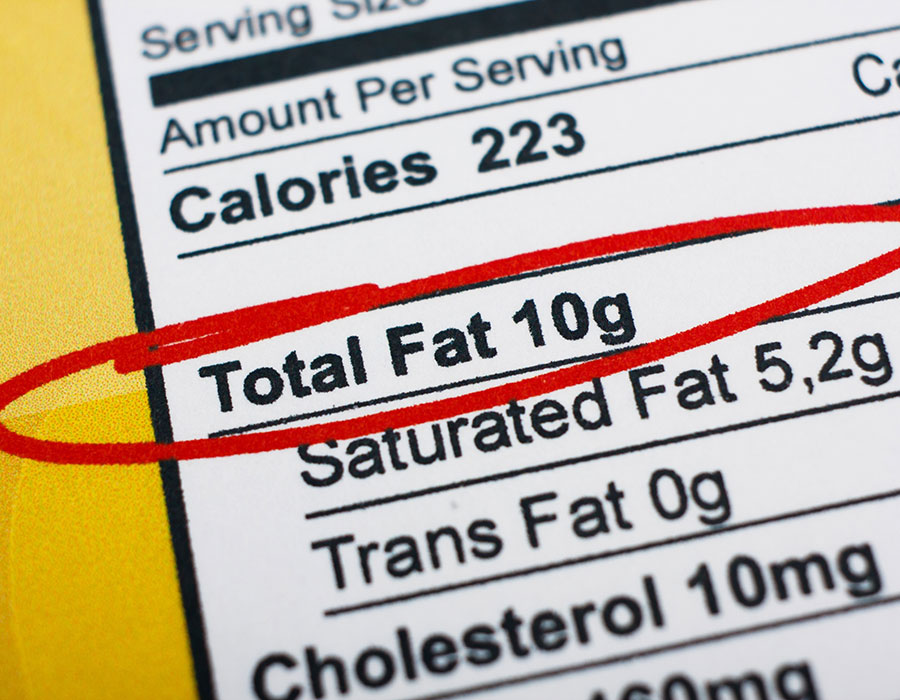
It is important to remember: Calories do not paint the full picture. It is more important to look at what nutritional value the calories you are consuming have, and the kind of ingredients a product contains. Instead of getting caught up in just the numbers, it is better to look at what the numbers stand for!
The fewer ingredients in a product, the less processed it usually is.
Choose products that are lower in:
- Trans and saturated fats
- Added sugar
- Sodium
Instead, prioritize products containing high amounts of:
- Protein
- Fiber
- Calcium
- Vitamin A
- Iron
How many calories are you getting from which nutrient?
Carbs = 4 kcal / g
Fats = 9 kcal / g
Proteins = 4 kcal / g
Alcohol = 7 kcal / g
Here you can see the amount of energy (kcal) you get per g of a nutrient.
Example:
Say a product has 8g of fat. In this case, 72 kcal of this product are coming from fat (8g of fat x 9 = 72 kcal)
(This does not mean you should get hung up on calories, but it is just good to keep in mind that the amount shown in g does not necessarily transparently reflect the energy distribution of the macronutrients!)